




Stuck in Ascendant With Great Aim? Your Headshot Percentage Is Hiding the Real Problem
Your tracker says your aim is Immortal. Your rank says Ascendant. The gap is usually not the final flick; it is how the fight started. Here is a 10-death audit that finds the real leak.
The short answer: your aim is probably fine, and that is exactly the problem. A high headshot percentage grades the bullets that landed. It says nothing about how many fights you walked into already losing: two angles open, nobody ready to trade, crosshair still solving the last corner. At Ascendant, that is where most rounds leak.
- Headshot % only counts shots that hit. Whiffs, deaths before you fired and fights you should never have taken are invisible to it.
- Two deaths that both feel like “I whiffed” can have completely different causes, and only one of them is fixed by aim training.
- Classify 10 deaths before watching the final shot. Whatever repeats is your next session’s only goal.
“My headshot percentage is Immortal level, so my aim isn’t why I’m stuck. I just need to grind more aim training or get better teammates.”
✕ Verdict: MisleadingHeadshot % describes how clean your hits are, not whether the duel was winnable. A death where you exposed yourself to two players, with no trade ready, can still end with a perfect headshot on the first one. The stat records the finish and ignores the setup.
0 missed shotsare counted in a hits-based headshot %What Headshot Percentage Actually Measures
Most trackers work out headshot percentage as head hits divided by all hits. Check your own tracker’s definition, but if it uses hits, the bullets that missed never enter the sum. Neither does the death where the enemy killed you before you fired once.
So the number answers one narrow question: when you connect, do you connect with the head? That is useful. It is also nowhere near the whole duel. Pros made the same point in DBLTAP’s 2022 interviews: 100 Thieves’ Derrek put crosshair placement, positioning and crossfires right next to raw aim, because a duel is a team situation long before it is a mouse movement.
Riot also retired ACS for Performance Score in patch 13.06, which now counts trades and adjusted deaths. Even Riot decided kills and damage alone were telling players the wrong story.
Execution Failure vs Preparation Failure
Every death that feels like a whiff falls into one of two buckets.
Execution failure: the shot was sensible, the fight was fair, and you missed. That belongs in the aim trainer.
Preparation failure: you arrived with your crosshair on the wrong angle, fired while still moving, or asked yourself to beat two players with nobody ready to punish your death. Hitting a better flick here is an incomplete fix. The fight was already expensive.
| Death type | What you see on the replay | Real fix |
|---|---|---|
| Blind exposure | Two or more enemies could see you at once | Clear one angle at a time, use cover or utility |
| Moving shot | You fired before you stopped | Stop, then shoot (movement drill, not tracking) |
| Unready crosshair | Your crosshair was on the last corner when they appeared | Pre-place before the peek, not during it |
| Isolated fight | No teammate could trade within a second or two | Wait for, or call, a ready trade |
| Clean duel lost | One enemy, crosshair ready, standing still, you missed | This one is aim. Train it. |
Only the last row is an aim problem. If it is the row you blame for every death, you will keep buying aim routines for the other four.
The Same Miss, Two Different Lessons
Round 4: you clear an isolated angle with a teammate right behind you, the enemy steps out, you miss a normal shot. Clean duel lost. Put it in practice.
Round 9: you swing while your Sova is still holding his drone, and the defender you peek has a second player watching the same space. You miss again. A faster flick would not have saved this. Even if you hit the first player, the second one was waiting, and nobody on your team was ready to trade either.
Same feeling on the death screen. Two different causes. If you file both under “aim inconsistency”, you lose the information that matters.
The 10-Death Audit
Pick your last ranked match. Open the replay or your own recording, take the first ten deaths, and for each one pause two seconds before the enemy appears. Ask three questions before you watch the shot:
- How many enemies could see me at the moment of contact?
- Was a teammate ready to trade, not just alive somewhere nearby?
- Was my crosshair already where the enemy appeared?
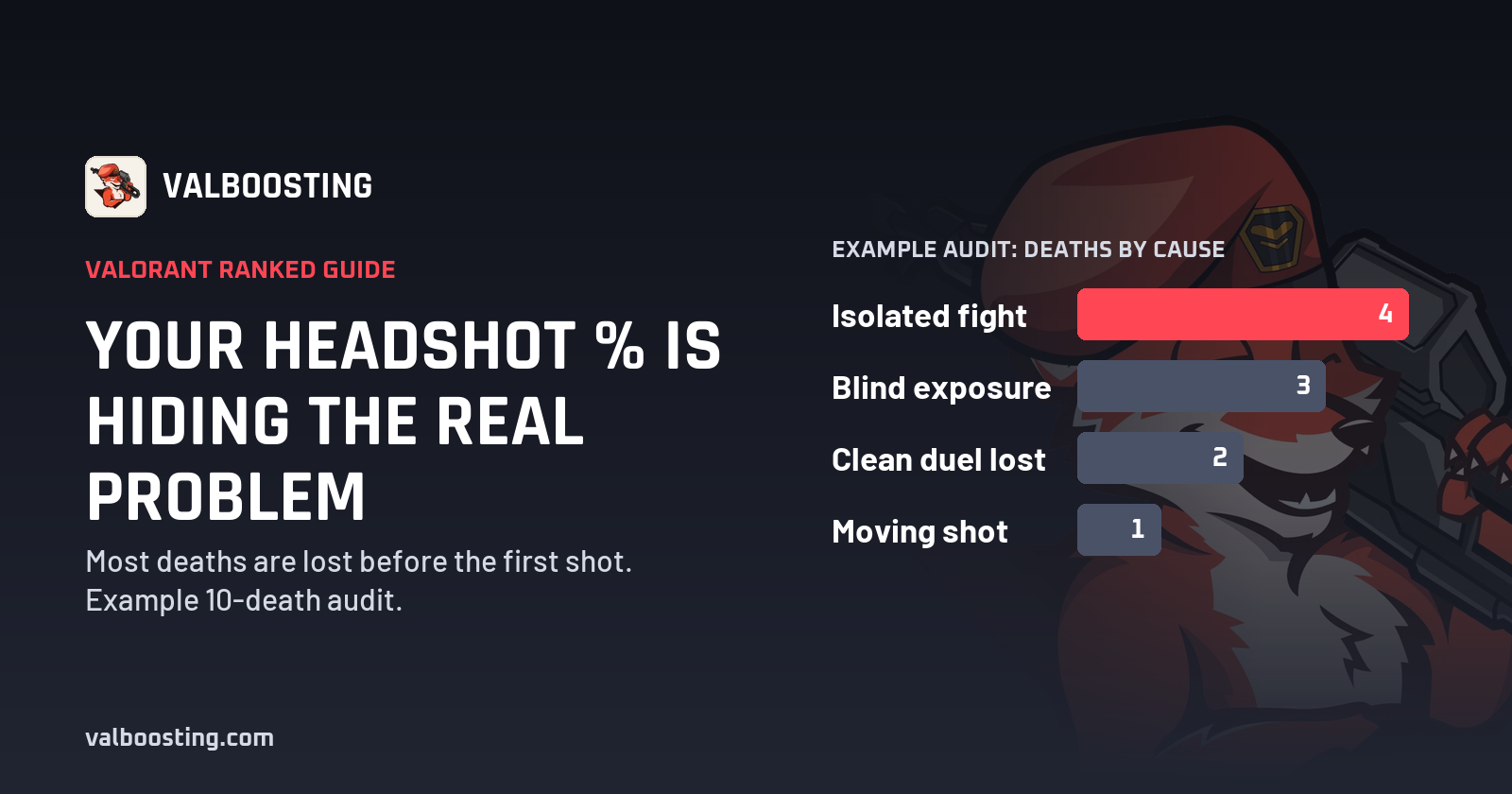
Then assign the death to one row of the table. Here is what a finished audit can look like, as an illustration rather than recorded data:
A player with this result does not need another hour of Gridshot. They need to stop taking fights their team cannot follow up. That is one goal for the next session, and it is measurable: run the same audit afterwards and see whether “isolated fight” shrinks.
This is a diagnostic habit, not a scientific measurement of your skill. Ten deaths is a small sample. It is still far more information than a headshot percentage gives you.
Winning deathmatch proves my aim is ranked-ready.
Deathmatch removes trades, utility and the decision to fight at all. It tests one part of a ranked duel well and the rest not at all.
Better teammates would fix my rank.
Teammates matter, but an isolated fight is usually a timing choice you made. You can wait for the trade.
Crosshair placement counts as aim.
It does, and it is the part that happens before the enemy appears, which is exactly what a headshot stat cannot see.
What To Do Next Session
Choose one setup error from your audit and play every round around it. If it was isolated fights, do not peek until someone is close enough to trade. If it was blind exposure, clear one angle at a time. Only when your audit shows mostly clean duels lost is more aim training the right answer.
You swing a site alone, kill one defender with a headshot, then die to the second. What does your headshot % say about that fight?
- It drops, because you died
- Nothing about the death; it only records the hit that landed
- It rises, so the fight was good
A hits-based headshot % only sees the bullet that connected. The real lesson is the isolated two-player fight.
If you want someone to run this audit with you, our Valorant coaching sessions go through your own replays with a high-rank player. Or queue with one: duo boosting puts an experienced teammate beside you who trades your fights properly, which is the exact skill this article is about.
FAQ
Why am I stuck in Ascendant with good aim?
Usually because fights are lost before the first shot: too many angles exposed, no trade ready, or a crosshair that was still on the last corner. Audit ten deaths before training more aim.
What is a good headshot percentage in Valorant?
It depends on your tracker’s formula and your role, so compare yourself only with the same tracker. More importantly, a good number does not prove your duels were well set up.
Does headshot percentage affect RR?
No. RR is driven mainly by match result and round difference, with a small individual-performance factor. Headshot % is not part of it.
How many deaths should I review?
Ten from one match is enough to spot a repeating category. Repeat after a few sessions to see whether that category shrinks.
- DBLTAP: Valorant pros explain what to improve to climb ranked (2022), Derrek on crosshair placement, positioning and crossfires.
- VALORANT patch notes 13.06: Performance Score replaces ACS.
- Riot Support: How RR is calculated.
- Death categories, audit method and example chart: our own framework. The chart is illustrative, not recorded match data.
- Change log: checked against V26 Act 6, patch 13.08, October 2026.


