You Didn’t Lose That Angle Because Your Reaction Time Is Bad
Dying before you can even react feels like a reflex problem. Usually it is not. Riot's netcode numbers, plus a four-question hold checklist, show what is really deciding those fights.
The short answer: peeker’s advantage is real, but it is rarely why you lost the angle. Riot measured it in tens of milliseconds. Most lost holds are decided earlier: you were watching too wide an area, checking a second entrance, or standing where the attacker already knew to aim. Fix those before you change your sensitivity or buy a faster monitor.
- The peeker sees you first because of network and rendering delay. Riot cut it, but it can’t reach zero.
- A hold also loses to geometry, attention and predictability, and those are often bigger.
- Pause your clip before contact and ask what you still had to solve.
“I keep dying the instant they peek. My reaction time must be bad, or peeker’s advantage just makes holding pointless.”
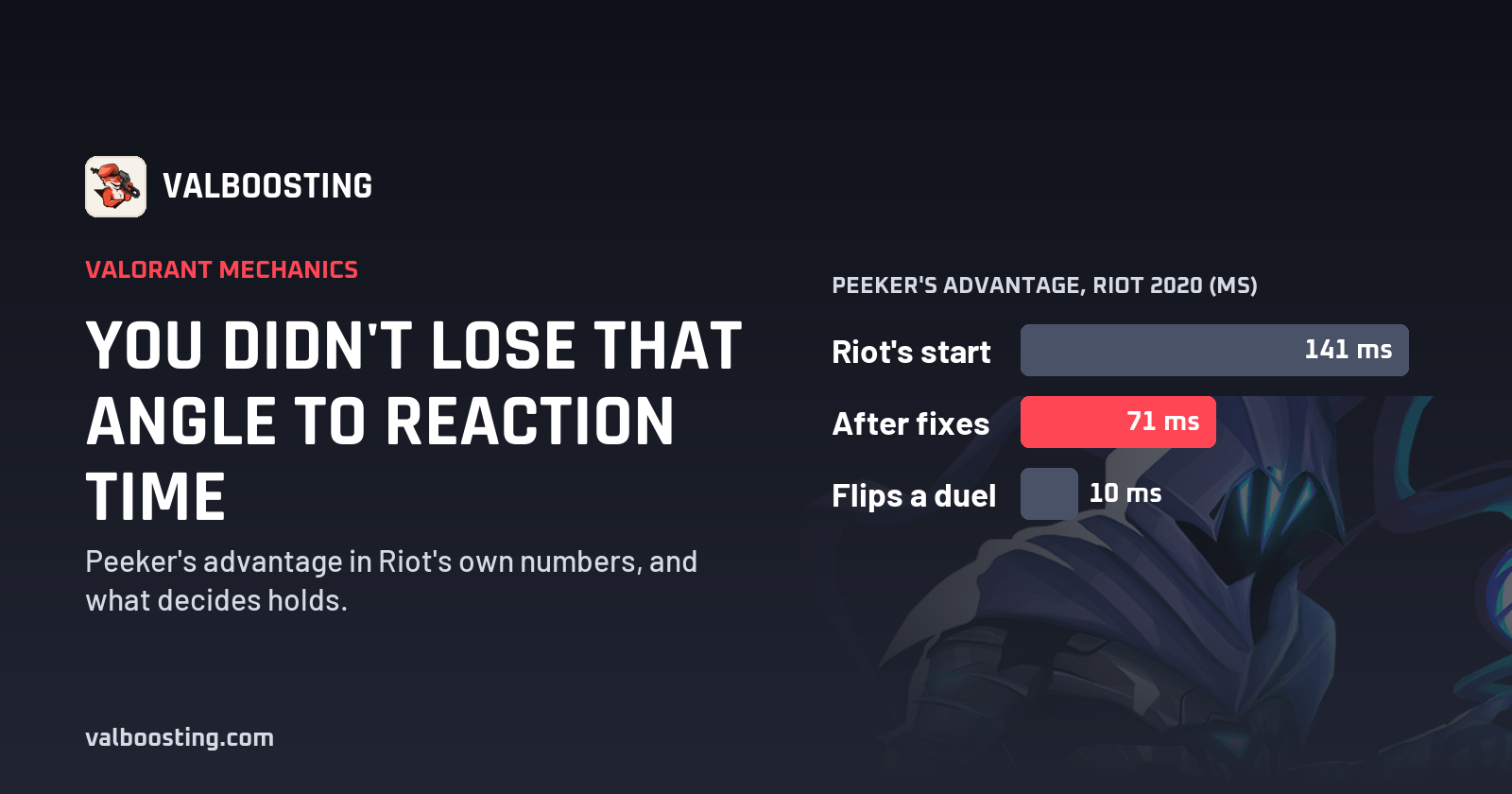
✕ Verdict: MisleadingRiot’s 2020 netcode article put the gap at about 71 ms at 144 FPS after its fixes. That decides close fights, and Riot treats it seriously. But a holder who is mid-check on a second angle, or watching the wrong width, gives away far more time than that. Riot’s own playtests show how sensitive the timing is:
10 msmoved a test duel from 90% holder wins to 90% peeker winsWhat Peeker’s Advantage Actually Is
When a player peeks, their own game shows the movement at once. Your game only shows it after their input travels to the server, gets processed, and comes back to you (the general problem of netcode), and then your PC has to draw it. That delay is peeker’s advantage. Riot explained all of it in Peeking into VALORANT’s Netcode in 2020.
These are 2020 numbers from a developer article, not a current measurement of your connection. Treat them as scale, not as a stopwatch. Riot’s goal was a slight holder’s advantage through design: attackers often have one way in, shoulders show before heads, moving shots are inaccurate, and players slow down when tagged.
What Riot Says You Can Do About It
Riot’s own list is short, and none of it is a trick:
- Higher frame rate and refresh rate, so updates appear sooner on your screen.
- React to the in-game network warnings. Riot’s example is switching to a wired connection to cut packet loss.
- Pick the network buffering setting that fits your connection: smoother movement versus lower delay.
Do those once. Then stop. No setting cancels latency, and nothing on that list fixes a hold you set up badly.
Four Ways a Hold Loses Before the Peek
| Problem | What you see on the replay | Fix |
|---|---|---|
| Split attention | You glance at a second entrance as they swing | Get a teammate on the second threat, or give one up |
| Wrong width | Crosshair on a narrow peek, they wide-swing | Hold from further back, or match the swing you expect |
| Predictable spot | They pre-aim your exact head before appearing | Change position after it gets you a kill once |
| Too many contacts | Several players could swing on you at once | Fall back, use utility, or play for a trade |
Every row hands the attacker time. A split-attention flick or a wrong-width hold can cost you far more than the network delay above, and none of it is about how fast your hand moves.
The Hold Was Hard Before the Peek
An illustrative example. You defend a site from a spot that sees the main entrance, and every few seconds you check a side door too. The attacker swings main during one of those checks. You die before your crosshair arrives. It looks like an impossible reaction test.
It wasn’t. You gave the attacker a moment when you weren’t looking, and they used it. The fix is a teammate on the side door, a position that only sees one entrance, or utility that tells you when someone is coming. A new mouse would not have helped.
Passive Hold or Information Peek?
Holding is not the only option. A quick, deliberate peek for information turns the timing advantage around: now you are the one who appears first. The risk is giving away your position or dying early with no trade ready. The safest pattern is to peek with a reason, take the information, and get back behind cover, with a teammate ready to trade if it goes wrong.
Peeker’s advantage makes holding pointless.
It makes bad holds worse. Riot designs maps and movement to give holders a slight edge, and good holds still win.
A faster monitor fixes instant deaths.
Higher frame rates help a little, which is why Riot recommends them. They don’t fix split attention or a predictable spot.
Small timing gaps decide fights.
Riot’s tests found that 10 ms could swing duels from 90% one way to 90% the other.
The Four-Question Hold Check
Pause your replay a second before contact and answer:
- Was I watching one threat, or splitting between two?
- Did my crosshair cover the swing they actually made, wide or tight?
- Had I already shown this spot, this round or earlier?
- Could more than one attacker see me at the same time?
If you answer badly to any of these, you have found something more useful than “my reaction is slow”. It is the same idea as our 10-death audit: review the setup, not just the final shot.
You die holding A Main while turning to check A Link. What is the real cause?
- Peeker’s advantage
- Slow reaction time
- Split attention between two entrances
The attacker swung while you weren’t looking. Cover one entrance and let a teammate, or utility, cover the other.
Want a high-rank player to watch your holds with you? Our coaching breaks down your own clips. Or play beside one: in a duo boost your partner covers the second angle so you never have to split.
FAQ
Is peeker’s advantage real in Valorant?
Yes. Riot explains it as network and rendering delay that lets the peeker see the holder slightly first. Riot reduced it but says it can never be fully removed.
Why do I die instantly when holding angles?
Often because of how the hold was set up: split attention, the wrong width, a predictable spot or too many attackers. Peeker’s advantage adds a few tens of milliseconds on top.
Does higher FPS reduce peeker’s advantage?
Yes, a little. Riot’s article shows a lower peeker’s advantage at 144 FPS, and recommends higher frame and refresh rates.
Should I peek or hold in Valorant?
Hold one threat with a clear plan, or peek on purpose for information with a trade ready. Avoid holds that ask you to watch two places at once.
- Riot Games: Peeking into VALORANT’s Netcode (July 28, 2020). The millisecond figures are Riot’s from 2020 and are not current measurements.
- Wikipedia: Netcode.
- Hold problems, checklist and example: our own analysis, illustrative rather than recorded.
- Change log: checked against V26 Act 6, patch 13.08, October 2026.