
Winning More Than You Lose but Still Losing RR? Do the Arithmetic First
55% win rate, 100 games, and you are 65 RR lower than where you started. That is not a rigged matchmaker, it is arithmetic. Here is your break-even win rate and what to do about it.
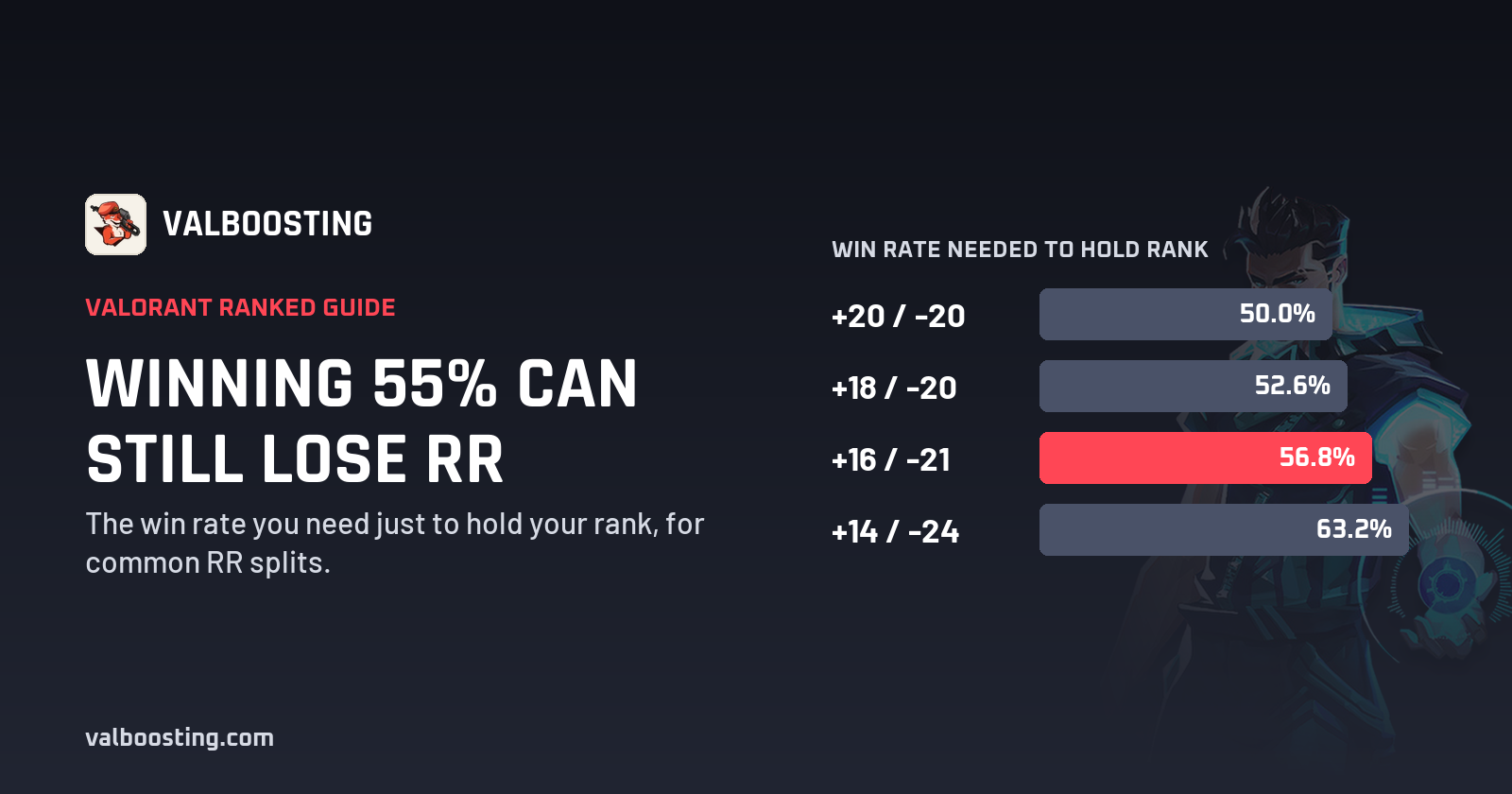
The short answer: when a win pays less than a loss costs, winning most of your games is not enough. At +16 RR per win and −21 per loss, you need 56.8% wins just to stand still. Win 55 out of 100 and you finish 65 RR lower. That is not the matchmaker forcing you down. It is the price of each result, and you can calculate it.
- Break-even win rate = average loss ÷ (average gain + average loss).
- At +16 / −21 that is 56.8%. A 55% player slides about one tier every 150 games.
- Uneven payouts usually mean your rank sits above your hidden MMR. They shrink as the two meet.
“I win more games than I lose, so I should be climbing. If my RR is going down at 55%, the system is keeping me stuck.”
✕ Verdict: MisleadingA positive win rate only climbs when wins and losses are worth about the same. Riot says smaller gains and bigger losses mean your rank has moved above your MMR, and the game is pulling it back. At +16 / −21, holding rank takes:
56.8% winsso 55% loses about 65 RR per 100 gamesWhy 55% Can Still Drop You
Take a block of 100 games. You win 55, each worth +16, and lose 45, each costing −21.
Here is the part people miss: turning one loss into a win is worth 37 RR, not 16. You gain the win and you avoid the loss. Three more wins out of those 100 games and you are back above zero.
The Break-Even Win Rate
Break-even win rateaverage loss ÷ (average gain + average loss). Above it you climb. Below it you slide, even while winning most of your games.
Turn on JavaScript to use the calculator. Example: at +16 RR per win and −21 per loss, you need 56.8% wins to hold your rank.
The same formula for common splits, worked out by us:
| RR per win / loss | Win rate to hold rank | What it usually means |
|---|---|---|
| +25 / −15 | 37.5% | MMR well above rank: you climb even while losing more than you win |
| +20 / −20 | 50.0% | Rank roughly matches MMR |
| +18 / −20 | 52.6% | Slightly above MMR |
| +16 / −21 | 56.8% | Above MMR: 55% still slides |
| +14 / −24 | 63.2% | Well above MMR |
At +16 / −21 a 52% player loses about 1.8 RR a game (a tier every ~57 games), 55% loses 0.65 (a tier every ~154), and 60% gains 1.2 (a tier every ~83). That is why a winning month can feel pointless.
Why Your Payouts Are Uneven
Riot’s RR page names four factors: the result, the round difference, a small individual-performance factor, and rank convergence. The last one is the usual culprit. When your visible rank climbs past your hidden MMR, Riot shrinks gains and grows losses to pull the badge back. It is the same catch-up idea as an Elo rating.
Two other things lower payouts without saying anything about your MMR:
- Close games. A 13-11 win pays less than 13-3. If your wins are tight and your losses are stomps, your split will look worse than your skill.
- Five-stacks. A full premade can lose 0% to 90% of its RR, depending on the rank spread in the party.
Riot also adjusted RR calculations in patch 13.00 so players who keep winning feel less stuck, and asked Immortal+ players in particular for feedback. If your notes on payouts are older than June 2026, take them again.
What the Arithmetic Proves, and What It Doesn’t
It proves why your RR went down. It does not prove why your payouts are set where they are. You cannot reverse-engineer Riot’s hidden coefficients from one screenshot, and nobody outside Riot can.
Keep two things apart. Your match history is what happened: add up the real gains and losses. The model is a scenario: it assumes today’s averages stay fixed, and they don’t. As rank and MMR converge, the split moves back toward even. A fixed-payout projection is not a life sentence for your account.
The game forces you to stay at 50%.
It builds even matches, which pulls you toward 50% at your real level. That is not the same as handing you losses.
A high K/D means your MMR must be high.
Individual performance is a small factor. Results and round difference carry far more weight.
You can raise your MMR in a loss.
Riot says an exceptional performance in a loss can raise MMR, though you can never gain RR from a loss.
The 20-Game Check
Same queue, same party size, same time of day. Log 20 games: result, score line, RR change. Then put your averages into the calculator.
- Break-even above your win rate: you are above your MMR. Keep winning; the gap closes and the split evens out.
- Break-even near 50%: rank matches MMR. Only a higher win rate moves you now.
- Wins small only in close games: your problem is closing games out, not the system. Bigger margins pay more.
You gain 18 RR per win and lose 20 per loss. What win rate holds your rank?
- 50%
- About 53%
- About 57%
- 60%
20 ÷ (18 + 20) = 52.6%. Below that you slide; above it you climb.
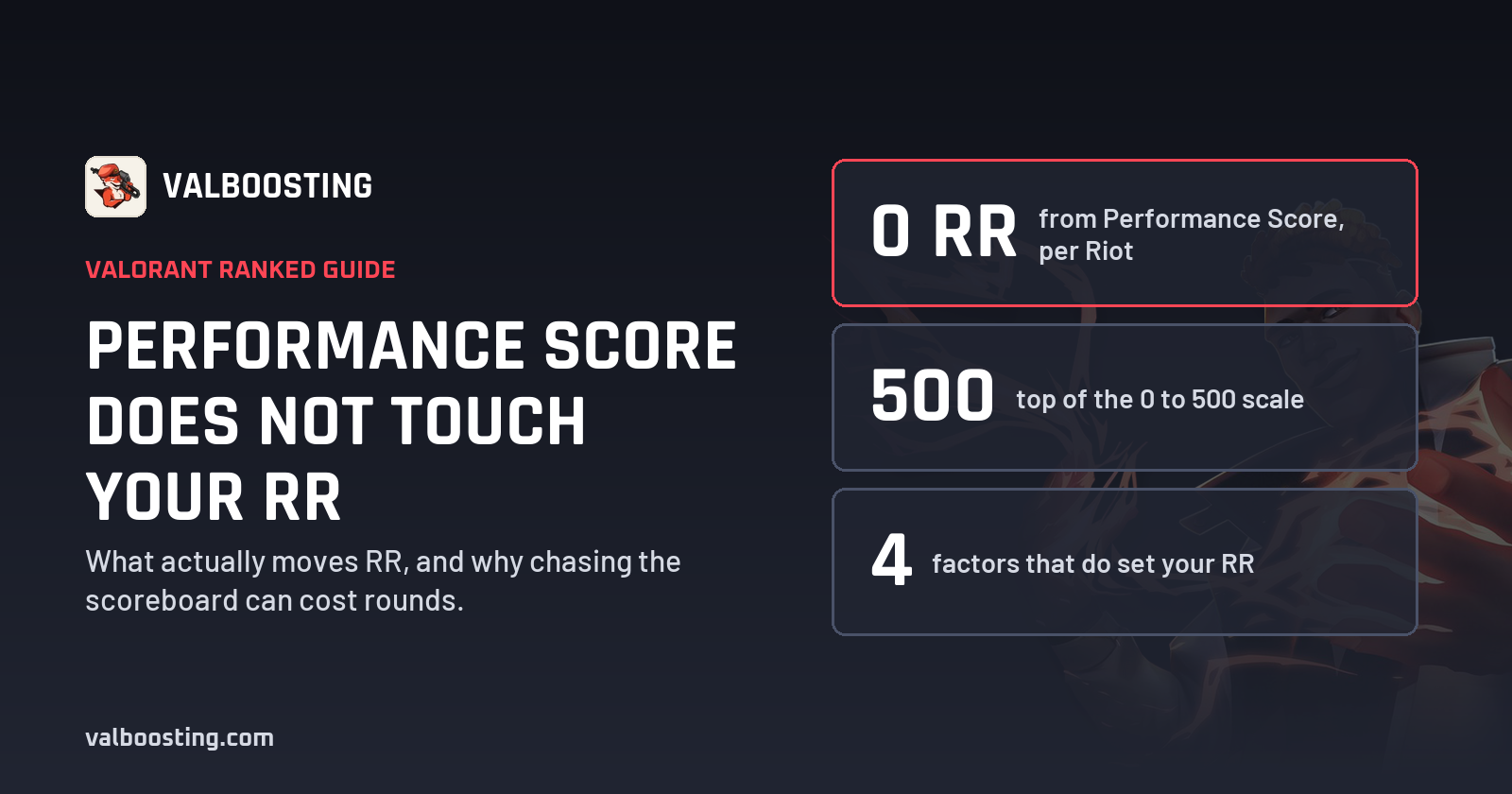
Stuck being corrected every game? Coaching finds the habits behind lost close games. Or skip the grind: our rank boost and pay per win win real matches, so rank and MMR rise together. And if the scoreboard is what feels unfair, read why Performance Score does not affect RR.
FAQ
Why do I gain less RR than I lose in Valorant?
Usually because your rank is above your hidden MMR, so Riot’s rank convergence shrinks gains and increases losses. Close wins and five-stack penalties also lower gains.
What win rate do I need to rank up if I lose more than I gain?
More than your break-even rate: average loss ÷ (average gain + average loss). At +16 / −21 that is 56.8%.
Will my RR gains go back to normal?
Yes, if you keep performing at your level. Each match moves rank and MMR closer, and payouts even out as they meet.
Is the matchmaker keeping me stuck on purpose?
The arithmetic explains the net loss without any hidden rule. It cannot prove why your payouts are set where they are, so neither can a theory built on one screenshot.
- Riot Support: How RR is calculated: the four factors, rank convergence, five-stack penalty.
- Patch notes 13.00: RR calculation adjustments (June 2026).
- Wikipedia: Elo rating system.
- Break-even formula, tables and the 100-game example: our own arithmetic, assuming fixed average payouts.
- Change log: checked against V26 Act 6, patch 13.08, October 2026.