
Valorant Map Rating Explained: Your Worst Map Might Be One Bad Half
Got a C on a map and want to dodge it forever? Map Rating packs four stats into one letter, and it only started counting on October 13. Here is how to read it without fooling yourself.
The short answer: Map Rating is useful once you split it apart. It combines four stats into a single 0 to 500 number and a C to S grade. A bad grade can mean you lose every attack half, or that one retake keeps collapsing, or simply that you have played the map four times. The letter cannot tell you which. Your next ten minutes of review can.
- Map Rating = overall, attack and defense win rate plus Performance Score, weighted towards recent games.
- Everyone started at zero on October 13, 2026. Early grades rest on a handful of matches.
- Before you dodge a map or change agent, find the side, the phase and the repeating error.
“Map Rating shows which maps I’m bad at. If it says C, that map is my weakness and I should dodge it or switch agents.”
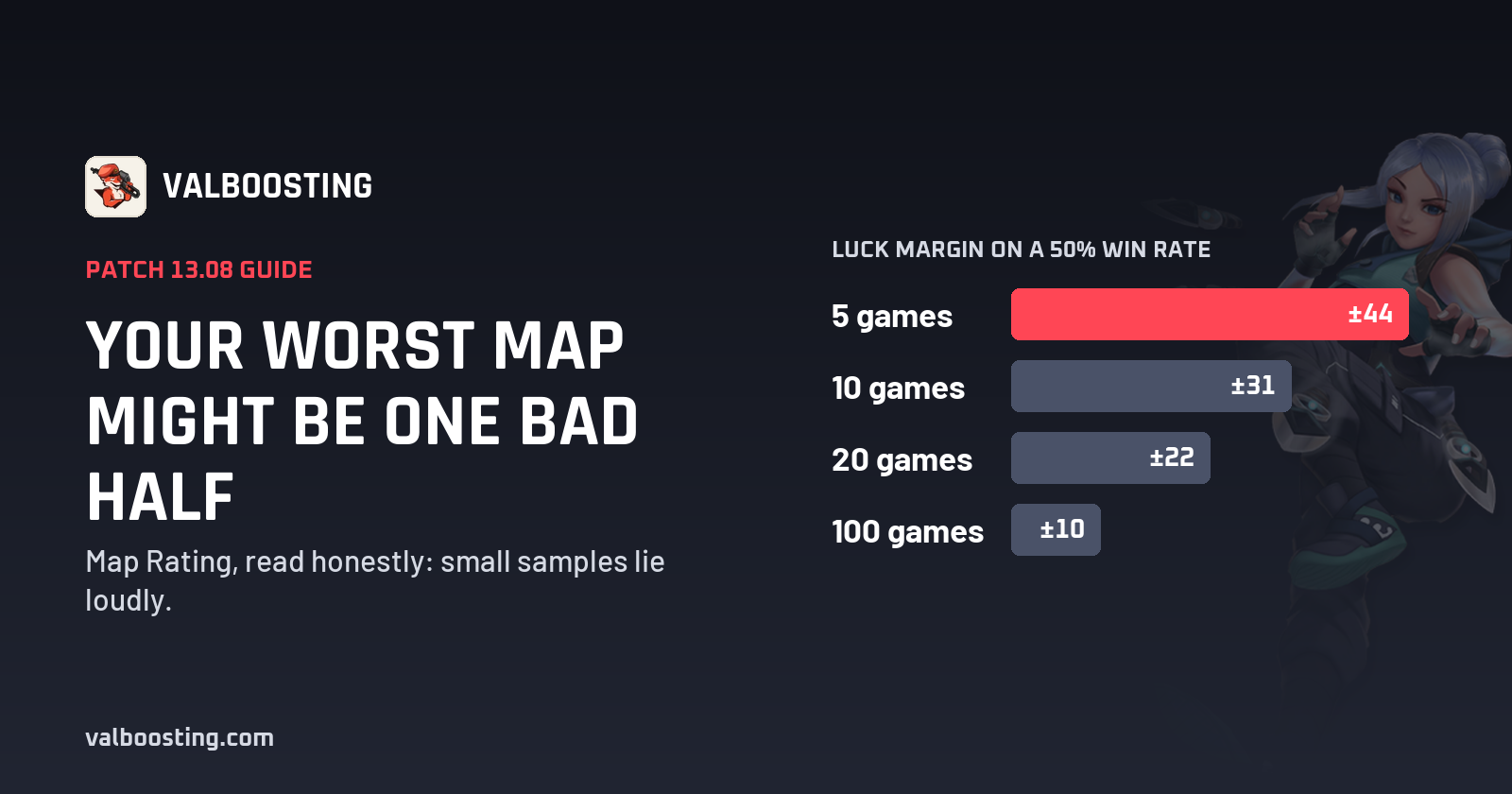
✕ Verdict: Half trueThe grade points at a map, not at a problem. It blends attack and defense, leans on your most recent games, and started with no history at all. Over a small sample the win rate inside it is mostly noise. At 10 games, a 50% player’s measured win rate can land anywhere within:
±31 points95% margin on a 10-game win rateWhat Goes Into the Grade
Patch 13.08 introduced Map Rating with these rules:
| Rule | What it means for you |
|---|---|
| Four stats: overall, attacker and defender win rate, plus Performance Score | One letter hides two very different halves |
| Recent matches count more | A bad weekend can sink a grade quickly, and lift it just as fast |
| Everyone started fresh at launch | Every grade is built on games since October 13, 2026 |
| Private, Competitive and Premier only | Nobody else sees it, so there is no point playing for it |
It shows in Agent Select, End of Game and Career. Bind and Corrode also came back into the Competitive pool in the same patch, with Ascent and Split rotated out, so some of your grades will be built on maps you have barely touched in months.
Small Samples Lie Loudly
A win rate over a few games swings wildly by chance alone. Here is the 95% margin of error around a true 50% win rate, from the standard binomial formula, worked out by us:
Five games on a map can show 20% or 80% for a player who is exactly average there. Map Rating also uses Performance Score, which steadies it a bit, but the win-rate parts carry this noise. Treat any grade from under 20 games as a hint, not a verdict.
“I’m Bad on This Map” Is Too Broad to Fix
“I’m bad on Bind” feels like a diagnosis because it names a place. In practice it bundles several unrelated problems into one identity. One player defends well and stalls every attack. Another reaches good post-plants and loses the same retake over and over. Giving both a generic map guide wastes their time.
Break the map into four phases you can actually review:
- Opening contact: who dies first, and where?
- After first information: does your team hit, rotate or freeze?
- Commitment: does the hit arrive together, or one player at a time?
- Conversion: do you win the post-plant or the retake once you are there?
Then split by side. Map Rating already shows attacker and defender win rate separately, so start there.
Fixing “Bad Attack” Without Changing Agents
Say your review finds that attack rounds keep stalling after the first defender reacts. The entry waits for a call, utility gets spent with nobody following it, and the team hits with 20 seconds left. That is a decision problem in one phase.
The first fix is a rule, not a pick: “when we get first info on a site, we commit within ten seconds, or we rotate”. A new agent only helps if its kit solves that specific stall. It will not supply the missing decision.
| Side | Phase | Repeating error (example) | One rule to test |
|---|---|---|---|
| Attack | After first info | Team freezes, hits late | Commit or rotate within 10 seconds |
| Attack | Opening | Entry dies alone at mid | No mid fight without a trade ready |
| Defense | Conversion | B retake arrives one by one | Group at one spot before going in |
| Defense | Opening | Same off-angle punished every round | Change position after it works once |
The rows are hypothetical examples. Make your own with your real errors, one row per map, and only test one rule at a time.
A low Map Rating hurts your RR on that map.
Nothing in the patch notes links Map Rating to RR or matchmaking. It is a private review tool.
Recent games weigh more.
Riot says recent matches contribute more than older ones, so the grade can move quickly.
Switching agents fixes a bad map.
Only when the new kit solves the specific failure you found. Otherwise you carry the same problem on a new character.
Recheck the Grade Honestly
After a week with your rule, ask two questions. Did the error you targeted happen less often? And did the grade move because you played better, or because you played a different mix of games, a duo, or a new agent? Only the first answer means something changed.
Performance Score is one of the four inputs, so read what Performance Score is and is not for before you try to push the grade by chasing kills.
You have a C on Corrode after 6 games: defense half fine, attack half poor. What is the first step?
- Dodge Corrode until the grade recovers
- Switch to a different duelist
- Review the attack rounds for one repeating error
Six games is a tiny sample, and the split already tells you where to look. Find the repeating attack error first.
Want a second pair of eyes on your weak half? Our Valorant coaching reviews your own rounds map by map, or duo boost with a high-rank player and learn the map from beside them.
FAQ
How is Valorant Map Rating calculated?
From four stats: overall win rate, attacker win rate, defender win rate and Performance Score, with recent matches counting more. It shows as 0 to 500 and a C to S grade.
Can other players see my Map Rating?
No. Riot says other players cannot see your Map Rating information.
Does Map Rating count old matches?
No. Everyone started fresh when it launched in patch 13.08 on October 13, 2026.
Which modes count for Map Rating?
Competitive and Premier.
- VALORANT patch notes 13.08: Map Rating rules and map pool changes.
- Riot Support: Performance Score.
- Wikipedia: Binomial proportion confidence interval.
- Margin-of-error chart: our own arithmetic (normal approximation, 1.96 × √(0.25 ÷ n)). Worksheet rows are hypothetical examples.
- Change log: checked against V26 Act 6, patch 13.08, October 2026. Recheck if Riot changes the grade’s inputs.